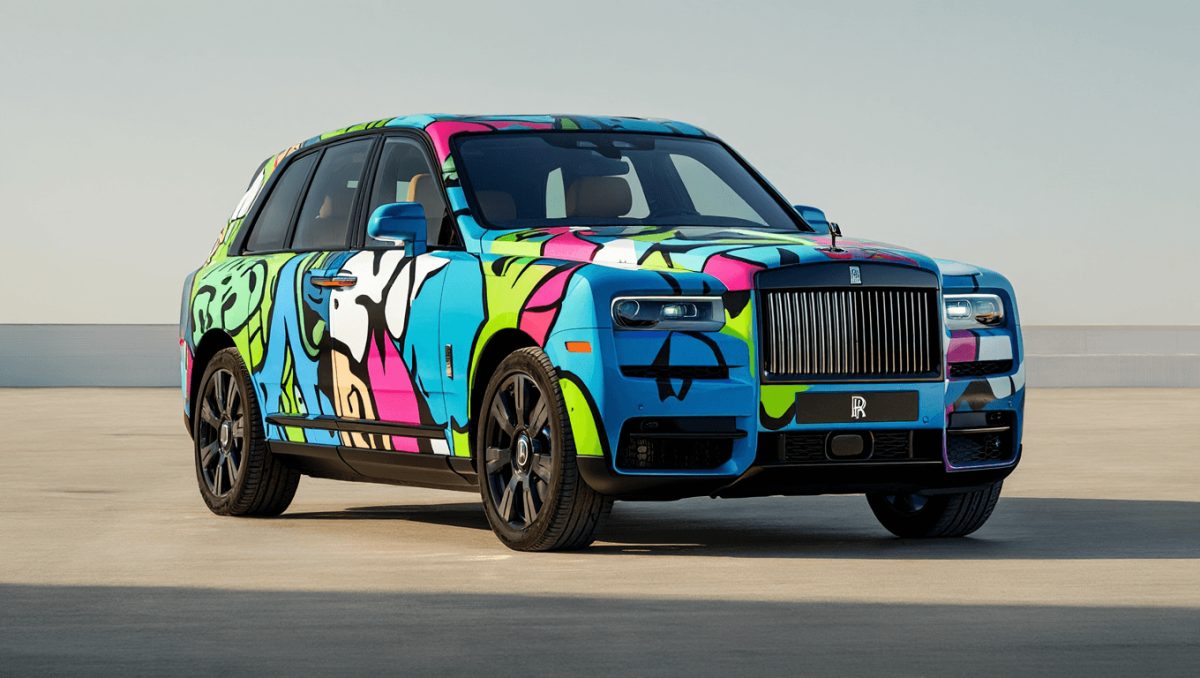
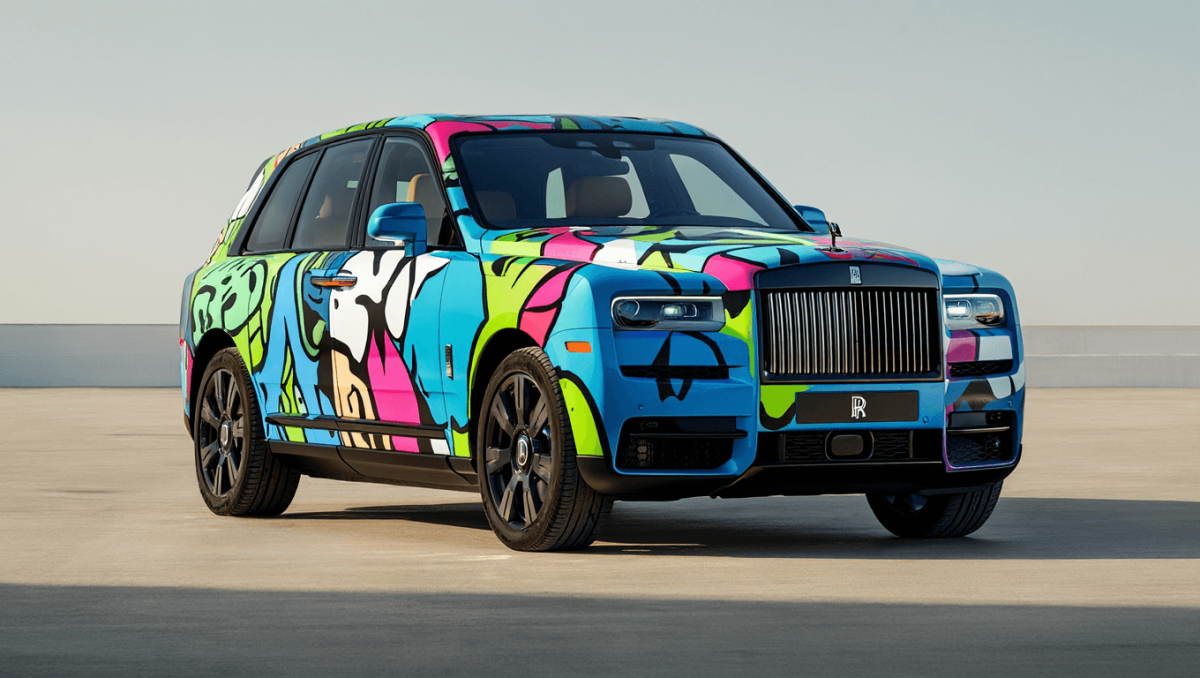
This week Rolls‑Royce and French street‑art pioneer Cyril Kongo unveiled a limited run of five Black Badge Cullinans that bring a deliberately confrontational aesthetic to the marque’s most imposing SUV. The project recasts the Cullinan as a mobile artwork — a rare move for a manufacturer that normally trades in restrained luxury — with clear implications for collectors and for how high‑end automotive brands engage with contemporary art.
All five cars are finished in a layered paint scheme that places iridescent blue metallic particles within the clearcoat, over a deep black base. The manufacturer calls the effect Rolls‑Royce Blue Crystal: visually subtle from a distance but striking close up, where the micro‑flakes catch the light and add depth to the surface.
More overt is the coachline work. Each car carries a hand‑applied stripe that blends two colours into a gradient, and Kongo intentionally varies the palette from side to side. That asymmetry extends to the wheels: the brake calipers are painted in different hues at each corner, turning normally overlooked details into deliberate focal points.
Rolls-Royce Black Badge Cullinan unveiled with Cyril Kongo graffiti finish
Esteban Ocon rubbishes Haas exit rumours: fiercely rejects claim he’s leaving
Inside, the collaboration is more radical. Kongo personally hand‑painted the timber veneers in a palette of saturated tones; every panel is unique. Rolls‑Royce technicians then protected those panels with ten layers of lacquer before installation. The painted timber appears on the doors, dashboard, fold‑out picnic tables and on the waterfall section between the rear seats — a centrepiece of Cullinan interiors.
The hand‑painted approach continues across the cabin: the Starlight headlining carries coloured finishing, seat piping and leather inserts contrast sharply with surrounding trim, and the lambswool floor mats pick up accent shades. Door cards are embroidered with motifs drawn from Kongo’s visual vocabulary, while bright leather inserts are echoed on the dash.
Externally, the cars also depart from convention: traditionally bright chrome elements have been rendered in black, including the Pantheon grille, the Spirit of Ecstasy and the inner surfaces of the flat “RR” monogram. Mechanically, however, the vehicles remain standard Black Badge Cullinans — this is an artistic commission rather than an engineering reinterpretation.
- Edition size: Five uniquely finished Black Badge Cullinans
- Exterior finish: Rolls‑Royce Blue Crystal over black, asymmetric coachlines, blacked trim
- Interior treatment: Hand‑painted timber (10 layers of lacquer), coloured Starlight headlining, embroidered door cards
- Technical changes: None; chassis and powertrain unchanged
- Pricing: Not disclosed by Rolls‑Royce
The decision to commission a well‑known graffiti artist signals a broader cultural shift: luxury marques are increasingly using collaborations to demonstrate cultural currency and to reach different collector circles. Limited runs such as this tend to perform well at auction thanks to their scarcity and the name of the collaborator — factors that will shape resale values and future bidding interest.
For enthusiasts and prospective buyers the appeal is obvious: each car is a one‑off in the literal sense, with exterior and interior details that cannot be replicated. For Rolls‑Royce the exercise is a controlled experiment in how far the brand can stretch its image while maintaining the technical and finishing standards expected of its flagship models.
Rolls‑Royce has not published prices for the five Cullinans. Beyond the immediate spectacle, the collaboration is notable for how it positions the automaker within contemporary art conversations — and for how it reframes a supremely conventional luxury object as a personal statement on wheels.